Sep 4, 2010

Norway marks International Quds Day - #BDS

Hundreds of Christians and Muslims marched towards Norway's parliamentary buildings to commemorate International Quds Day in the country's capital.


The annual rally which takes place on the last Friday of Ramadan, saw demonstrators shouting slogans demanding an end to the ongoing Israeli occupation of Palestinian land and a boycott of Israel. 

Several leading Palestinian figures as well as representatives from Muslim communities in Norway also gave speeches at the rally. 

The rally was held a day after Israeli Prime Minister Benjamin Netanyahu and acting Palestinian Authority Chief Mahmoud Abbas held the first round of talks in Washington on Thursday. 

The thorniest issues between the negotiating sides are Israel's refusal to halt its illegal settlement activity in the West Bank and East al-Quds (Jerusalem). 

The settlements and their unrecognized counterparts known as outposts have been characterized by the United Nations Security Council, the International Court of Justice, the European Union, Amnesty International and Human Rights Watch as built in violation of international law. 

Iran to publish Israeli-linked firms list - #BDS

Iran will publish a list of Israeli-linked companies by next week to apply sanctions against them, Iran's Vice-President for Parliamentary Affairs Mohammad-Reza Mir-Tajeddini says.


Iran's Foreign Ministry presented a list of multi-national companies with Israeli connections to the Majlis National Security and Foreign Policy Commission last week, Mir-Tajeddini told Mehr news agency on Monday. 

The Iranian official further pointed out that the list will be published in the media upon an agreement made by the Iranian Parliament and the country's government. 

He went on to say that Israel has an influential economic cartel across the world and it is constantly establishing new companies under new brands and Iran will expose them after the anti-Israel sanction is applied. 

Israeli goods banned on Quds Day in US - #BDS

American demonstrators marking International Quds Day have announced that they would boycott Israeli products as an indication of their support of the Palestinian nation.


Americans staged rallies in the US capital Washington on Friday along with other Muslims across the world to mark International Quds Day, IRIB reported. 

At the end of the rallies, a statement was issued in which those participating said they would no longer use goods from Israel and the major US companies which support Israel to show their unity with the Palestinians. 

The ralliers supported the Palestinians' right to defend themselves and choose a government. 

In the statement, they also called for a referendum to be held, in which all Palestinians -- Muslims, Christians and Jews -- could determine their future. 

They said that all Palestinians from all religions should enjoy equal rights. 

The International Quds Day was designated by the late Founder of the Islamic Republic, Ayatollah Rouhollah Khomeini. 

The day is observed on the last Friday of the Muslim fasting month of Ramadan, during which Muslims across the world hold rallies in support of their brothers in faith, the Palestinians. 

Boycott Movement Targets Israel: a Just boycott - #BDS

When does a citizen-led boycott of a state become morally justified?

That question is raised by an expanding academic, cultural and economic boycott of Israel. The movement joins churches, unions, professional societies and other groups based in the United States, Canada, Europe and South Africa. It has elicited dramatic reactions from Israel’s supporters. U.S. labor leaders have condemned British unions, representing millions of workers, for supporting the Israel boycott. American academics have been frantically gathering signatures against the boycott, and have mounted a prominent advertising campaign in American newspapers - unwittingly elevating the controversy further in the public eye.

Israel’s defenders have protested that Israel is not the worst human-rights offender in the world, and singling it out is hypocrisy, or even anti-Semitism. Rhetorically, this shifts focus from Israel’s human rights record to the imagined motives of its critics.

But “the worst first” has never been the rule for whom to boycott. Had it been, the Pol Pot regime, not apartheid South Africa, would have been targeted in the past. It was not — Cambodia’s ties to the West were insufficient to make any embargo effective. Boycotting North Korea today would be similarly futile. Should every other quest for justice be put on hold as a result?

In contrast, the boycott of South Africa had grip. The opprobrium suffered by white South Africans unquestionably helped persuade them to yield to the just demands of the black majority. Israel, too, assiduously guards its public image. A dense web of economic and cultural relations also ties it to the West. That — and its irrefutably documented human-rights violations — render it ripe for boycott.


Sep 3, 2010

International Day of Al-Quds - #BDS

Churches standing up to 'pro-Israel' politicians - #BDS

The Australian Jewish News (AJN) was outraged. Its editorial in late July condemned the National Council of Churches in Australia (NCCA) for a resolution calling on Australians to boycott Israeli goods made in the occupied Palestinian territories.
The AJN wrote that the move contributed to a global campaign to 'delegitimise' Israel and lent 'credence to the perception of an apartheid state.'
Executive Council of Australian Jewry president Robert Goot, in a letter to the National Council of Churches’ general secretary, alluded to the Churches' alleged complicity in the Holocaust. The motion 'revived painful memories for Jews in Australia of earlier times in Europe when churches allowed themselves to be swept up in the tide of popular prejudices against the Jewish people.' Any moves to end West Bank settlements, illegal under international law, were framed as unbalanced and biased against Israel and Jews.
Relations between the Jewish and Christian establishment remain strained despite meetings with representatives to calm the atmosphere.

TUC likely to push for full Israel boycott - #BDS


The Trades Union Congress is expected to call on its members at its annual conference to strengthen opposition to Israel by extending boycotts and encouraging disinvestment.
A motion on Israel and the Palestinians, backed by the GMB, the Fire Brigades' Union, the Public and Commercial Services Union and the Transport Salaried Staffs' Association, is expected to propose a full boycott of Israeli goods.
The four-day conference begins in Manchester on September 13.
Eric Lee of TULIP (Trade Unions Linking Israel and Palestine) warned that Israel supporters should "not expect good news" from the congress.
Trade Union Friends of Israel (TUFI) will host a fringe meeting discussing the role unions can play in the peace process. TUC general secretary Brendan Barber has been invited to speak at the event.

Massive Attack back #BDS

Robert del Naja of Massive Attack tells William Parry why he is boycotting Israel

The movement for a cultural boycott of Israel in response to its treatment of the Palestinians, modelled on the boycott of Apartheid South Africa, could eclipse decades of disingenuous political charades by engaging Western intellectuals, academics and artists. Internationally renowned figures such as Naomi Klein and Ken Loach have supported the call, and now one of Britain's most successful bands, Massive Attack, is publicly backing the boycott.
"I've always felt that it's the only way forward," Robert del Naja, the band's lead singer tells me when we meet at the Lazarides gallery in Soho, London. Del Naja is an artist as well as musician and his face and fingers are speckled with paint. Dozens of copies of his pictures are strewn all over the wooden floorboards, drying. "It's a system that's been applied to many countries. It's a good thing to aim for because it applies the continual pressure that's needed."
Musicians have a long history of rallying the public to supporting political causes. The global anti-apartheid movement got the fillip it desperately needed when musicians began supporting it. The single "Sun City" by Artists United against Apartheid in 1985 and the 70th birthday tribute concert for Nelson Mandela at Wembley in 1988 catapulted the cause into  millions of ordinary homes.
"I definitely think musicians have a major role to play," says del Naja. "I find the more I get involved, the more the movement becomes something tangible. I remember going to 'Artists against Apartheid' punk gigs, and 'Rock against Racism' gigs around the same sort of time. Bands like the Clash and the Specials had a lot to say and a lot to do with influencing the minds of the youth in those days." Those formative experiences are still evident in Massive Attack's outlook today. A typical gig by the band is a blistering fusion of music with political messages and statistics flashed up on video screens, while the band regularly lend support to humanitarian causes.
Calls for a boycott were first issued five years ago by the Palestinian Campaign for the Academic and Cultural Boycott of Israel (PACBI), but a series of developments beginning with the Gaza war in January 2009 have led to a rise in support for the campaign. After Israel's deadly raid on the Free Gaza aid flotilla in May this year, a number of leading bands including the Pixies, Elvis Costello and Gorillaz cancelled concerts in Israel. In August, 150 Irish visual artists also pledged not to exhibit in Israel, but it is musicians who have been the most prominent international supporters of the boycott.
Their views are not unanimous, however. Other musicians, from Elton John to Diana Krall (Costello's wife), Placebo and John Lydon's Public Image Ltd have refused to cancel concert dates in Israel. Some have insisted that engagement with Israel is more productive, a stance that del Naja rejects. "We were asked to play Israel and we refused," he says. "The question was asked: 'If you don't play there, how can you go there and change things?' I said: 'Listen, I can't play in Israel when the Palestinians have no access to the same fundamental benefits that the Israelis do.' I think the best approach is to boycott a government which seems hell-bent on very destructive policies. And it's sad because we've met some great people in Israel and, you know, it's a difficult decision to have to make."
Beyond the arts world, an increasing number of trade unions, student unions and churches are signing up to the BDS movement. Even an Israel-based group, Boycott from Within, backs the campaign, stating that its government's "political agenda will change only when the price of continuing the status quo becomes too high . . . because the current levels of apathy in our society render this move necessary".
"We are not going to achieve a quick liberation," del Naja admits, but says the point is to apply "pressure, the continual pressure that's needed." And the threat of international isolation and economic repercussions is clearly starting to bite: Israel's parliament, the Knesset, recently passed the first reading of a bill that would impose heavy fines on Israeli citizens who initiate or support boycotts against Israel, and a bill to bar foreigners  - like del Naja - who do the same from entering Israel for 10 years.
"[The boycott] is not an action of aggression towards the Israeli people," del Naja says. It's towards the government and their policies. Everyone needs to be reminded of this because it's very easy to be accused of being anti-Semitic, and that's not what this is about."

Imaging Apartheid - Poster Project for Palestine - #BDS

As the global movement in solidarity with the Palestinian struggle for liberation continues to grow, we are calling on graphic designers and artists to submit their work to IMAGING APARTHEID: the Poster Project for Palestine.

Twenty-one posters will be selected from submissions collected from around the world to be either silk-screen or offset printed for exhibition in Montreal, and distribution internationally. Works will be selected by a jury of artists, graphic designers and social justice activists.

Street level art work and design has consistently played a critical role within international solidarity movements throughout the world: from the powerful poster art published by the Black Panthers in the late 1960s; to the striking design work created by artists inspired by the Africa National Congress (ANC) and the global movement against apartheid in South Africa; to poster art created to support the Popular Front for the Liberation of Palestine (PFLP) and the Palestinian Liberation Organization (PLO).

These works help to maintain collective and social memory of past anti-colonial struggles while providing inspiration for current movements fighting for social justice worldwide. Political posters act as the public face for voices that are too often marginalized and have the ability to visualize injustice, bridge gaps and imagine alternatives. IMAGING APARTHEID seeks to engage artists to continue this tradition, and assist in building broad artistic support for the growing political movement in support of Palestinian liberation.

IMAGING APARTHEID takes place within the context of the international Boycott, Divestment and Sanctions (BDS) campaign against Israeli Apartheid called for by over 170 grassroots Palestinian organizations from Palestine and the Diaspora in July 2005.

Submission deadline:
November 1st, 2010

Submissions should be sent in jpeg format and not exceed 2 MBs.
If your work is selected, you will be asked to provide a high resolution (minimum 300 dpi), print-ready digital file to a maximum size of 38” x25”.

Please send submissions to:
submissions@imagingapartheid.org

Should People Boycott Israel? #BDS

PAUL JAY, SENIOR EDITOR, TRNN: Welcome to The Real News Network. I’m Paul Jay. I’m in Ramallah, Palestine. And now joining us from ["la-ROOJ"] Café in Ramallah is Omar Barghouti. He’s a founding member of the Academic and Cultural Boycott of Israel. Thanks for joining us.
OMAR BARGHOUTI, PALESTINIAN CAMPAIGN FOR THE ACADEMIC AND CULTURAL BOYCOTT OF ISRAEL: Thank you.
JAY: So what is this boycott about?
BARGHOUTI: The Palestinian Campaign for the Academic and Cultural Boycott of Israel actually is one part of a general Boycott, Divestment, and Sanctions movement, or BDS for short. We started Academic and Cultural Boycott in 2004, and the general Boycott, Divestment, Sanctions campaign was in 2005. The BDS campaign, from the very first moment, was endorsed by more than 170 of the main groups in Palestinian civil society, including the major trade unions, women’s unions, political forces, NGOs, and so on and so forth. So this is a movement that has as close to a consensus as you can get, and it’s not just among Palestinians in the occupied West Bank, Gaza, including East Jerusalem, but also Palestinians inside Israel, and the largest component of the Palestinian people, those in exile in the Diaspora.

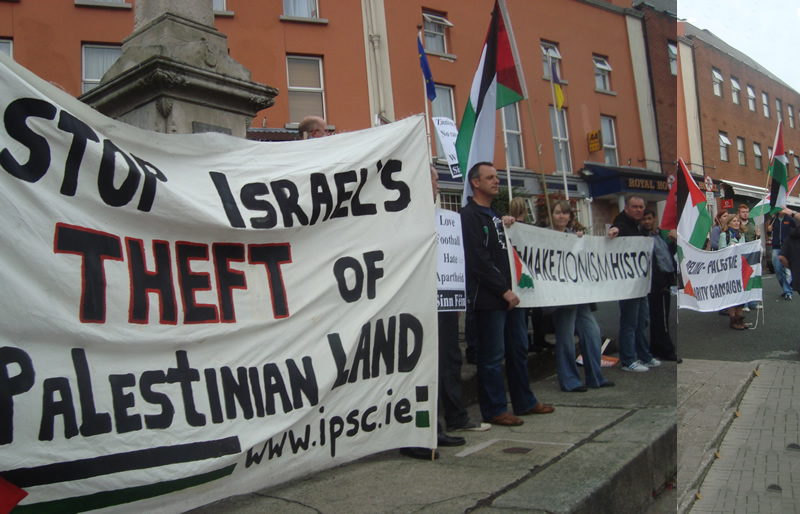
Protest at Ireland v Israel match as pro-Palestinian Activists Love Football and Hate Apartheid - #BDS


The protest begins outside the pre-match function in the Royal Hotel

In Bray on Wednesday 25th August over 60 members and supporters of the Ireland Palestine Solidarity Campaign (IPSC) took part in a demonstration as the Irish Women's soccer team played Israel in a FIFA World Cup Qualifier at the Carlisle Grounds (home of Bray Wanderers FC).

Before the match a pre-match dinner and reception was hosted by the Israeli Embassy at the Royal Hotel in Bray where the protest commenced. Two local Sinn Féin councillors, John Brady and Rossa Murray, who had received invites to this dinner attempted to enter the reception. Upon arrival the two councillors, who were wearing Palestinian football jerseys, were refused entry and were escorted out of the reception by Israeli security officials.

Contrary to the often expressed view that politics and sport do not mix, at this function the Israeli embassy staff handed out ridiculous pro-Israeli state propaganda directed against Palestinians.

Following the dinner, the protest then moved to outside the gates of the Carlisle grounds where the game was actually taking place.

Sep 2, 2010

Wikimania 2011 is set to take place in a country that walls people out of cities based on their ethnicity - #BDS


Wikimania is a conference held every year and attended by users of Wikipedia and other projects of theWikimedia Foundation, which prides itself on its mission of providing free knowledge and free access to knowledge for all. Holding Wikimania in Haifa, Israel is counter to the spirit, ethos, and goals of the Wikimedia Foundation. Here’s why:

    UBC Faculty of Law and Hebrew University Faculty Exchange - #BDS


    UBC is pleased to announce a faculty exchange program between the UBC Faculty of Law and Faculty of Law at Hebrew University of Jerusalem. Starting this September, and for the next two academic years, both Faculties will host a visiting professor from the other school, who will undertake a six to seven week short-term course or seminar in a topic of their choosing.
    "UBC Law is always looking for opportunities where we can enhance the teaching and learning experience through interdisciplinary study and international engagement," says UBC Law Dean, Mary Anne Bobinski. "This partnership with Hebrew University is an important step towards achieving that goal and were certain that the experience will be valuable for both our faculty and students."
    Like UBC, Hebrew University is also considered to be one of the top universities in the world according to the annual QS World University Rankings.
    Barak Medina, Dean at the Faculty of Law, Hebrew University says, "We are very excited to launch this exchange program with UBC. The program will provide opportunities for cooperation of researchers from both institutions, and may also enable us to establish in the near future a student-exchange program. We are grateful to the Canadian Friends of the Hebrew University and the donors, who made this exchange program possible."
    The program starts in September at UBC with Dr. Tomer Broude, Senior Lecturer, Faculty of Law and Department of International Relations, Hebrew University. Dr. Broude will be teaching an intensive course this semester entitled Topics in International Law & Transactions Dispute Settlement in the WTO: Law, Policy and Procedure.


    Jewish Defense League planning to disrupt pro-Palestinian rally in London - #BDS

    LONDON: The organizers of the Al-Quds (Jerusalem) Day Rally in London, on 4 September, 2010, have called on pro-Palestinian and anti-fascist groups to come out to show solidarity against counter-demonstrations organized by Zionist and Fascist groups.
    Police have warned the organizers that the English Defense League (EDL), March for England and the Jewish Defense League (JDL) groups are planning to try to disrupt the event, which is organized by Muslim groups but supported by others including the Stop the War Coalition and Jews Against Zionism.
    Since last year’s Al-Quds Day event, which was marked by confrontations with counter-demonstrators including the EDL and Zionist groups, supporters of the Palestinians have noted increasing cooperation between Zionists and far-right groups trying to disrupt pro-Palestinian demonstrations and activities.
    Al-Quds Day is an annual day of solidarity with the Palestinians and other oppressed peoples marked by Muslims around the world at the end of the holy month of Ramadan. (Al-Quds is the Arabic name for Jerusalem.) Rallies marking the day have been held in London annually since 1980. Supporters of the event in London this year include the Muslim Council of Britain, the Stop the War Coalition, Jews Against Zionism, the Islamic Forum of Europe and the Federation of Student Islamic Societies (FOSIS).

    Californians asked to restrict public retirement investments in Israel - #BDS


    Businesses related to the construction or maintenance of Israeli settlements, including those in the West Bank and East Jerusalem, or that provide military supplies and services to Israel would no longer be investment opportunities for the nation’s two largest public employee pension funds under an initiative that has been given the okay to gather signatures.
    If it makes it to the ballot, is approved by voters and survives the usual gauntlet of lawsuits, it would also require the Public Employees’ Retirement System and State Teachers’ Retirement System to urge these companies to stop those business activities, and, subject to fund fiduciary responsibilities, to divest from companies still engaged in these activities.
    It also would prohibit retirement funds from making new investments in these companies.
    The proponent for this measure, Chris Yatooma of Sacramento, must collect signatures of 433,971 registered voters – the number equal to 5 percent of the total votes cast for governor in the 2006 gubernatorial election – in order to qualify it for the ballot. He and his supporters have until Jan. 31, 2011 to do that.
    “We hope California will be the first state to apply a comprehensive divestment strategy that other states will follow,” Mr. Yatooma says on his website for the initiative. “This divestment approach looks to mirror the divestment strategy embodied by the worldwide anti-apartheid movement that toppled white rule in South Africa.”